Octo Browser is an antidetect browser for running large account farms: ad cabinets, social profiles, marketplace sellers, crypto wallets. Each browser profile carries its own fingerprint built from real device data, its own cookie jar, local storage and session history, so platforms see separate users instead of one machine with thirty tabs.
The pain it solves is familiar to anyone who has lost a cabinet to a “suspicious activity” check. Ad platforms and anti-fraud systems compare device parameters, network environment and behavioral signals across accounts. One shared canvas hash, one leaked WebRTC address, one reused cookie — and the whole net goes down together. Octo isolates each account into a standalone work environment that can be handed to a colleague, parked for months, or driven by automation scripts without the fingerprint shifting.
The service launched in 2021 and runs on Windows, macOS, Linux plus native mobile builds for iOS and Android. It fits solo media buyers on three profiles and agencies managing thousands across distributed teams. Try it.
Octo Browser at a glance
Before digging into features, here is the short technical card: what the product is, what it costs to start, and which parts matter most for media buying teams. Use it as a quick filter before reading the detailed sections below.
| Parameter | Value |
|---|---|
| Name | Octo Browser |
| Service type | Antidetect browser for multi-accounting and team work |
| Launch year | 2021 |
| Core features | Unlimited profiles with real-device fingerprints, 50+ manually adjustable interlinked parameters, Android mobile fingerprints, built-in proxy shop with residential and mobile traffic, UDP proxy support, full API automation, team roles and profile transfer without fingerprint change |
| Pricing | From 10 EUR/month (Lite, 3 profiles) |
| Free trial | Yes — via partner promo code (CPALIVE4 gives 4 days of Starter) |
| Support | Telegram support bot, in-client chat, available any time |
| Highlights | Built-in proxy shop, UDP proxy support, fingerprint quality, native iOS and Android apps |
Pros and cons
Octo’s strongest points cluster around fingerprint quality, infrastructure that comes bundled instead of bought separately, and team controls. The notes below are usage limitations rather than complaints — things to plan around when you pick a plan.
Features and functionality
The functional core is profile isolation: every profile is a full work environment with its own fingerprint, cookies, local storage and active sessions. Around that core Octo stacks three layers that matter in production — fingerprint generation, network infrastructure, and team plus automation controls.
Fingerprint work starts with the generation source. Octo builds prints from real device data rather than assembling random values, which keeps parameter combinations internally consistent — a GPU that matches the OS, screen metrics that match the device class, fonts that match the locale. The team pushes Chromium updates fast, which matters more than people expect: a profile running a version nobody else uses is itself a signal. You can spin up a profile in one click with automatic settings, or go manual across 50+ interlinked parameters when a specific platform needs a specific environment. Android mobile fingerprints are available as a separate profile type.
Networking is where Octo removes a whole purchasing step. Vetted residential and mobile proxy providers sit inside the client, with traffic packages for different volumes and discounts on large buys; the Octo team monitors stability on its side, so a dead pool is their problem rather than yours. On top of that there is UDP proxy support — aimed at anti-fraud systems that inspect QUIC and HTTP/3 behavior and at the broader industry shift to those protocols. For services already sensitive to UDP connections, this closes a gap that matters more every quarter.
Team and automation layer. Profiles move between team members without the fingerprint changing and without re-login, which means a farmer can hand a warmed account straight to a buyer. Folders, action history, and role-based access distribution keep large nets manageable and limit data-leak exposure when staff rotates. The API covers creating, editing, deleting and fetching profiles with specific fingerprint, proxy, cookie and tag settings, plus start and stop commands; it works from any programming language and with any browser automation library.
Security. Data sits in encrypted databases on the server side, account access is protected by two-factor authentication, and individual high-value profiles can be locked behind an additional password. Mobile builds for iOS and Android extend the same account to phones, which is useful at registration stage where anti-fraud checks on mobile traffic are typically lighter.
Pricing and plans
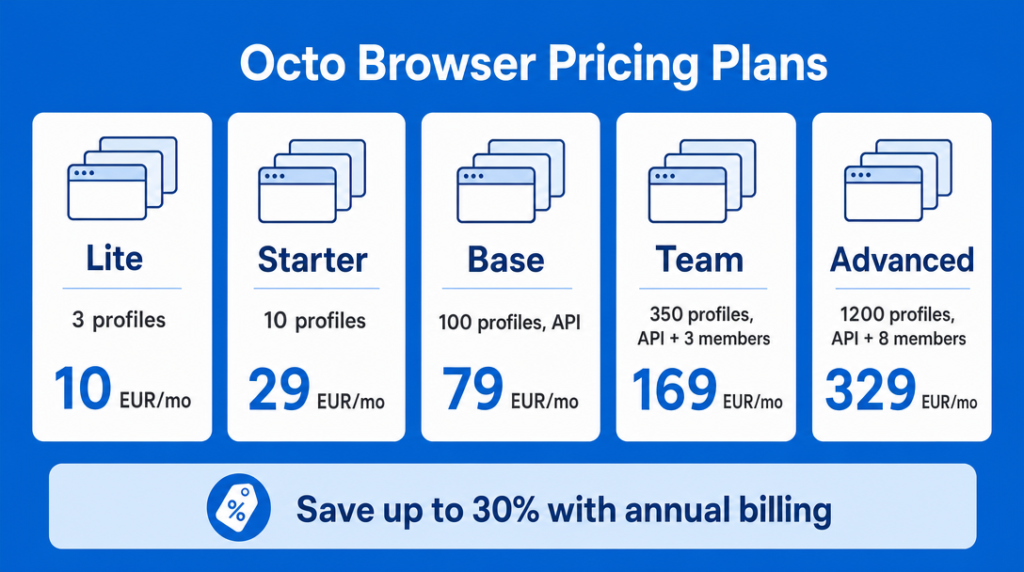
Pricing is public and profile-based: five subscriptions from 10 to 329 EUR per month, each expandable with extra profile packs and, on team plans, extra seats. API access appears from Base upward, team seats from Team upward. Long-term payment cuts the bill noticeably.
| Plan | Price | Profiles | Included extras | Expansion |
|---|---|---|---|---|
| Lite | 10 EUR/mo | 3 | — | — |
| Starter | 29 EUR/mo | 10 | — | Up to 30 profiles; +10 profiles = 10 EUR |
| Base | 79 EUR/mo | 100 | API access | Up to 200 profiles; +50 profiles = 35 EUR |
| Team | 169 EUR/mo | 350 | API access, 3 team members | Up to 600 profiles; +50 profiles = 15 EUR, +1 member = 15 EUR |
| Advanced | 329 EUR/mo | 1200 | API access, 8 team members | Unlimited; +100 profiles = 20 EUR, +1 member = 20 EUR |
Lite and Starter are entry points for solo buyers testing a vertical or running a handful of cabinets — enough isolation for manual work at a low entry cost. Base is the first plan built for scripted workflows: 100 profiles plus API for 79 EUR is where automation becomes cheaper than clicking. Team and Advanced serve distributed crews, with seats and role management priced in; Advanced removes the profile ceiling entirely, so farm departments with rolling thousands of accounts can expand in 100-profile steps.
Subscription length is the main lever on effective cost: three months takes 10% off, six months 20%, and twelve months 30%. For a team on Advanced the annual discount is substantial enough to plan budget around. Refund terms are published on the official site and clarified individually with support, and the comfortable way to evaluate the product is a trial promo code before committing to a paid period.
How to get an Octo Browser promo code
You don’t have to pay for a full subscription to use Octo Browser.
| CPALIVE4 — 4 days of the Starter subscription for free (for new users) CPALIVE — 30% off your first subscription purchase (for new users) |
Plus, the Octo Browser team periodically shares promo codes on their Telegram channel—subscribe so you don’t miss out on the savings.
Who it suits best
Octo fits anyone whose income depends on many isolated accounts surviving long enough to earn: media buyers, farm departments, agencies, airdrop hunters, multi-channel content teams. It is less relevant if you run a single account per platform and never touch automation or shared access.
For arbitrage and media buying, the case is direct. Google Ads, Facebook Ads and TikTok Ads cross-reference device parameters, network environment and behavior to link cabinets; one detected link cascades into bans and lost spend. Isolated fingerprints, separated cookie storage and per-profile interaction history keep cabinets apart, and the in-client proxy shop means the network side of the setup does not depend on a separate vendor relationship.
Farm and warm-up teams care about a different property: consistency over time. Mass registration is the easy part — trust is built by gradual activity inside a stable environment, and any abrupt change in fingerprint, IP or storage triggers checks. Profiles that retain full platform history across the account lifecycle are what preserve accumulated trust, which is also why clean profile handoff matters when a farmed account moves to the buyer.
Agencies and crypto users converge on storage and access control. For agencies running dozens of projects with hundreds of accounts, spreadsheets of logins eventually produce the same three incidents: uncontrolled access, two specialists in one profile at once, and lost access after someone leaves — role distribution and action history address all three. For airdrop work, activity often stretches over months: a profile with all its settings, cookies and local data can be reopened at token distribution in the same environment it was built in. Content monetization teams use the same mechanics to keep YouTube channels and market-specific social pages from ever touching each other.
Where to start. If you manage one or two accounts per platform from a single machine, Lite at 10 EUR covers the isolation you need without overbuying. If your workflow is script-driven from day one, plan straight for the Base plan rather than Starter, since API access begins there.
Verdict
Octo Browser sits at the infrastructure end of the antidetect market: fingerprints from real devices, a fast-moving Chromium core, proxies bought inside the client, UDP support ahead of the QUIC transition, and team controls that hold up when a crew grows past a few people. The pricing ladder is coherent — cheap enough to start solo at 10 EUR, deep enough to run unlimited profiles with eight-plus seats on Advanced — and the annual 30% discount makes long-horizon farming budgets predictable. The native iOS and Android apps are the practical differentiator for registration-heavy workflows.
CPA.LIVE readers get two promo codes: CPALIVE4 for 4 free days of the Starter plan, and CPALIVE for 30% off the first subscription purchase. Both are for new users, and the trial code is the sensible first step before paying for a period.
Media contact: @octobrowser_media_en Support bot: @octobrowser_support_bot Octo Club (EN): @octobrowser_antidetect_club_en Octo Club (RU): community chat
FAQ
How do I get a free trial of Octo Browser?
Which plan do I need for API automation?
What does UDP proxy support actually change?
Can I move a profile to another team member without breaking it?
Do I have to buy proxies separately?
What are the refund and billing terms?
How much can long-term payment save?
What do the mobile apps add over the desktop client?
How many profiles can I run on the top plan?
How fast is support, and where do I reach it?

Content verified by expert
On December 31, 2024, Dmitrii left his position as Head of Media Projects at ADSBASE Group. He currently leads CPA.LIVE and the ADDSET forum.
Holding numerous certificates, Dmitrii confirms his authority in digital marketing.

agent Author