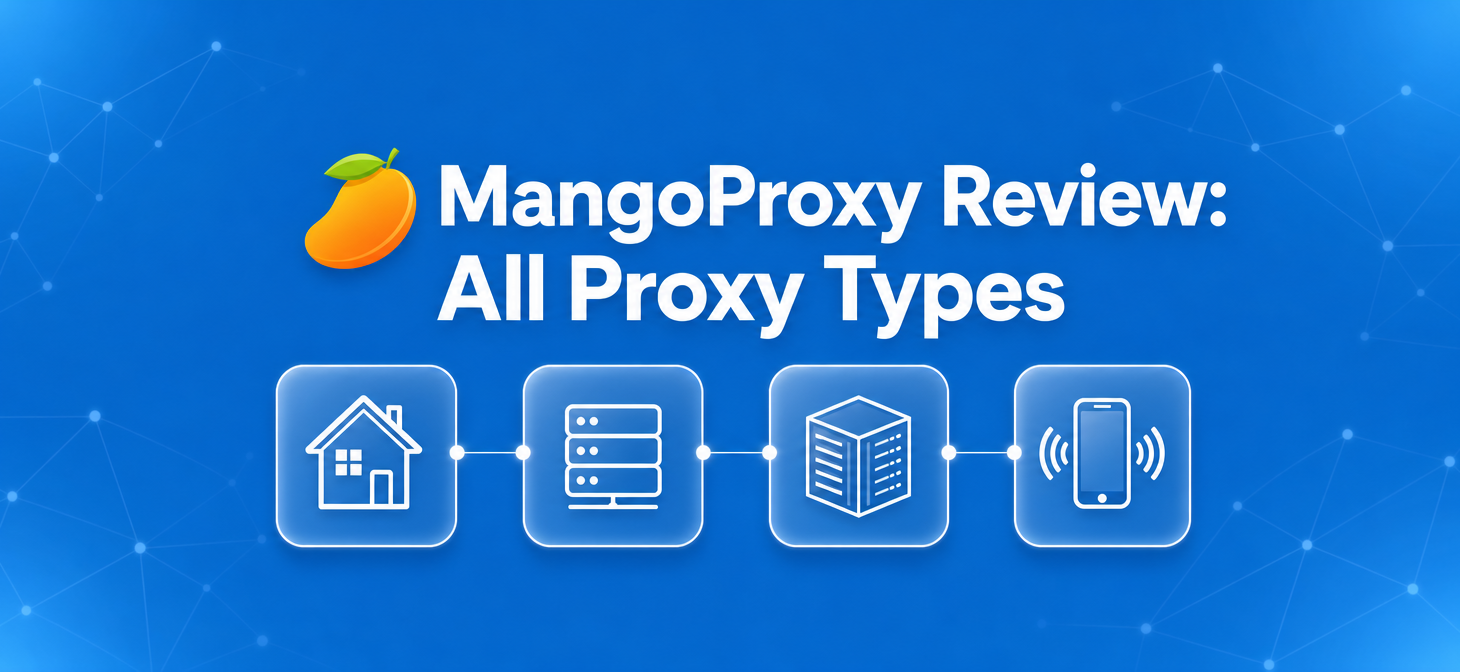
MangoProxy is a proxy provider that keeps four product lines — residential, ISP, datacenter and mobile — inside a single account, with both static and rotating IPs. The residential pool covers 90+ million addresses across 200+ countries, which is enough for ad account management, multi-accounting, SERP monitoring and large-scale parsing.
The pain it solves is fragmentation. Many teams end up with one vendor for mobile IPs, another for static ISP, a third for cheap datacenter traffic used in scraping — three balances, three dashboards, three support queues. MangoProxy consolidates that: you pick the IP type per task, top up one balance, and manage everything from the same panel or via API.
It is built for media buyers running multiple ad cabinets across GEOs, multi-accounting teams assigning a separate IP to each antidetect profile, SEO specialists checking localized output, and developers who need protocol-level flexibility (HTTP, HTTPS, SOCKS5) for parsers and automation scripts. Try it.
Parameters table
| Parameter | Value |
|---|---|
| Name | MangoProxy |
| Service type | Proxy provider (residential, ISP, datacenter, mobile) |
| Launch year | 2023 |
| Core features | 90M+ residential IPs in 200+ countries; static and rotating IPs; HTTP/HTTPS/SOCKS5; geotargeting by country, region, city, ASN and ZIP for supported types; rotation and sticky session control; dashboard + API |
| Pricing | From $0.60/GB (rotating datacenter), from $0.99/GB (Residential Light), from $1.43/IP (static datacenter) |
| Testing | Minimal paid package in your target GEO |
| Support | Daily 08:00–20:00 (GMT+3), email support@mangoproxy.com and website form |
| Highlights | Four proxy categories in one account, Residential Light launched in 2026, works with Dolphin Anty, Octo Browser, GoLogin and other antidetect browsers |
Pros and cons
Below is the short version for anyone scanning before reading the detail. The pros come from the feature set and published rates; the notes at the bottom are usage considerations that describe how to plan your first purchase.
Features and functionality
The functional core is choice of IP type plus granular control over how that IP behaves. You decide whether an address stays fixed for 30 days or rotates per request, how precisely it is geolocated, and which protocol your software talks to it with. Everything is provisioned from the web dashboard or through the API.
Proxy types and when each one earns its place. Static ISP addresses are the standard pick for long-lived ad accounts and anything that reacts badly to IP changes mid-session — the IP stays yours for the rental period and carries provider-level attribution. Static datacenter is the cheaper fixed option for internal tools, dashboards and tasks where IP origin matters less. Rotating residential suits GEO checks, localized testing and data collection that needs to look like ordinary household traffic. Mobile proxies cover the heaviest scenarios around mobile-first platforms, sold by rental period rather than by gigabyte.
Geotargeting depth differs by product. Standard residential supports targeting down to region, city, ASN and ZIP code, which matters when you verify how a campaign renders for a specific metro or want SERP data from one locality rather than a whole country. Residential Light, introduced in 2026, focuses on price: 85M+ IPs across 200+ countries with country-level selection, from $0.99/GB. For bulk parsing where you just need “any clean US IP”, the Light line is the economical lane; for ad verification in a named city, the standard residential line covers it.
Rotation control is where the rotating products get practical. You can let IPs rotate automatically, switch manually when a session goes bad, or hold a sticky session on one address for the supported duration — useful when a scraping flow needs to complete a multi-step login or checkout sequence on the same IP. Protocol support across HTTP, HTTPS and SOCKS5 means the same credentials work in a browser, a Python scraper and a desktop automation tool without reconfiguration tricks.
For multi-accounting, the integration story is intentionally boring: MangoProxy works with Dolphin Anty, Octo Browser, GoLogin and any antidetect browser that accepts standard proxy input, so each profile gets its own IP. No separate desktop client is required — Windows, macOS, Linux, Android and iOS are covered through compatible apps and browsers. Proxy quality is one input among many; profile fingerprints, warm-up behaviour and the content you run still shape what happens to an account on any given platform.
Pricing and plans
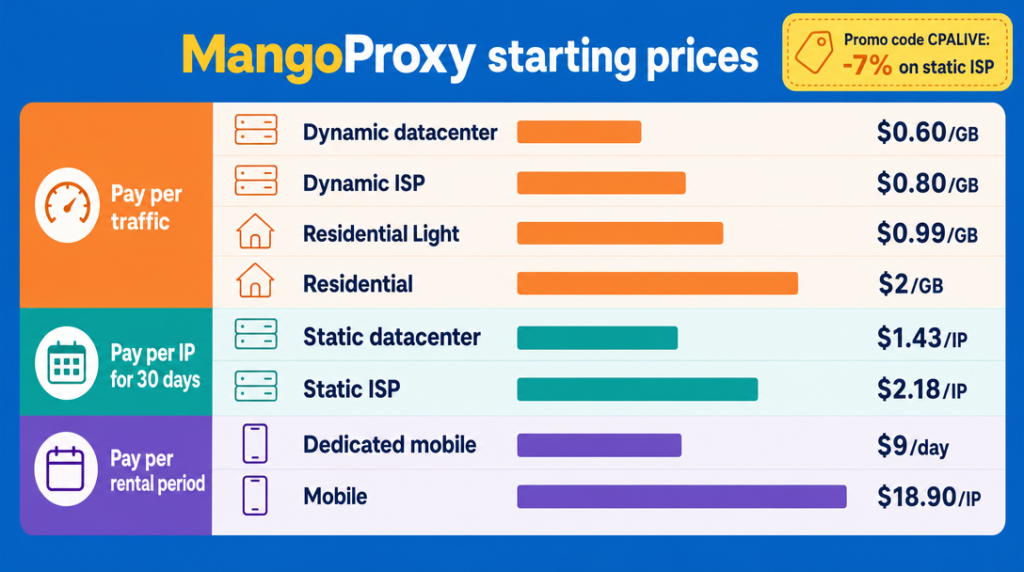
Pricing is public and per-product: rotating proxies bill by consumed traffic in gigabytes, static proxies by number of IPs for 30 days, and mobile proxies by rental period. Entry points range from $0.60/GB for rotating datacenter traffic to $18.90/IP for mobile. Larger packages get better unit rates.
| Proxy type | Billing model | Price from | Typical use case |
|---|---|---|---|
| Residential | Per GB | $2/GB | Ad verification by city/ASN, localized testing, SERP monitoring |
| Residential Light | Per GB | $0.99/GB | Bulk parsing and checks where country-level targeting is enough |
| Rotating ISP | Per GB | $0.80/GB | Data collection needing provider-attributed IPs with rotation |
| Rotating datacenter | Per GB | $0.60/GB | High-volume scraping of tolerant sources, price monitoring |
| Static ISP | Per IP / 30 days | $2.49/IP | Long-lived ad accounts, antidetect profiles, farm maintenance |
| Static datacenter | Per IP / 30 days | $1.43/IP | Internal tooling, dashboards, trackers, test environments |
| Mobile | Per IP / rental period | $18.90/IP | Mobile-first platforms, sensitive account work |
| Dedicated mobile | Per day | $9/day | Short intensive sprints on a channel nobody else touches |
Who each line suits in practice: a solo buyer running a handful of cabinets typically needs static ISP for the accounts plus a small residential balance for GEO checks. A multi-accounting team buys static IPs in bulk to match profile count and negotiates volume terms. A data or SEO team lives mostly on rotating datacenter and Residential Light, dipping into standard residential when city- or ASN-level precision is required.
Discount for CPA.LIVE readers. Promo code CPALIVE gives 7% off MangoProxy static ISP proxies. Individual terms for large packages and team-scale projects are arranged with the support team.
Testing runs on a paid package, refunds are generally not provided. Exceptions may apply as covered by the MangoProxy refund policy. The practical implication: start with the smallest viable package in your target GEO, confirm it behaves on your actual platform, then scale the order.
Who it suits
MangoProxy fits teams that need more than one proxy type and would rather not run three vendor accounts. If your workload mixes static IPs for ad cabinets, rotating residential for GEO checks and cheap datacenter traffic for parsing, consolidating onto one balance with one API is the main argument.
The clearest fits are media buyers and arbitrage teams juggling cabinets across multiple GEOs, multi-accounting operations that need a dedicated IP per antidetect profile, SEO specialists pulling localized SERP data, developers running parsers and automated test suites, e-commerce teams tracking competitor prices and assortment, and marketers verifying how placements actually render in a target market.
A couple of practical notes on planning. If your entire workflow sits on one narrow task — for example, mobile proxies for a single platform — the mobile line can be bought on its own and the rest of the catalog simply stays available for when the task list grows. And if your procurement process normally expects a pilot before payment, plan a small paid test batch instead; the support team can advise which type to test first and in which GEO.
Conclusion
MangoProxy positions itself as a one-stop proxy catalog rather than a single-product shop: residential, ISP, datacenter and mobile, static and rotating, 90M+ IPs across 200+ countries, managed from one dashboard and one API. For arbitrage and multi-accounting teams whose task list keeps changing, that breadth is the practical selling point — you adjust the IP type instead of adjusting vendors. The 2026 Residential Light line at $0.99/GB also lowers the entry cost for volume parsing noticeably.
Readers of CPA.LIVE can use promo code CPALIVE for 7% off static ISP proxies. Start small, verify behaviour in your GEO on your platform, then scale the package to get the volume rate.
Contact: @annamango_team Channel: @mango_proxy Support: support@mangoproxy.com (daily 08:00–20:00 GMT+3) X: @mangoproxy_ LinkedIn: MangoProxy
FAQ
Which proxy type should I pick for ad accounts?
What is the difference between standard residential and Residential Light?
How do I plan a first test purchase?
Can I use MangoProxy with antidetect browsers?
How are testing and refunds handled?
Do I need to install a separate desktop application?
How do sticky sessions work on rotating plans?
Are there discounts for large volumes or teams?
What can the API be used for?

Content verified by expert
On December 31, 2024, Dmitrii left his position as Head of Media Projects at ADSBASE Group. He currently leads CPA.LIVE and the ADDSET forum.
Holding numerous certificates, Dmitrii confirms his authority in digital marketing.

Evgeniya Shaforostova Author
A commercial copywriter with more than nine years of experience. Specializations: traffic arbitrage, cybersecurity, real estate, and legal services.