LuckyCards is a virtual card service for paying ad platforms and other merchants, issued out of the LuckyGroup ecosystem. It covers the usual pain points of card payments in affiliate marketing: cards that stop working mid-flight, frozen balances, slow refunds, and BINs that quietly lose pass rates on Facebook or Google. The service reports 98.7% successful payments across FB, Google, TikTok, Taboola and MGID, with 25+ BINs across three GEOs.
The backstory matters here. LuckyCards started as the internal payment layer for LuckyTeam, the media buying arm of LuckyGroup, and opened to external clients afterwards. Today 350+ LuckyTeam buyers spend through the same cards every day, which means any pass-rate issue hits the operator’s own spend before a client files a ticket.
The service fits solo buyers, media buying teams, farmers, SEO specialists and webmasters who need predictable card issuing at volume, plus team-level controls over who spends what. Try it — with promo code LIVE50 you get 50 free cards and a 3% top-up fee locked in permanently.

Key parameters
| Parameter | Value |
|---|---|
| Name | LuckyCards |
| Service type | Virtual cards for ad spend and merchant payments |
| Launch year | 2025 (part of LuckyGroup, 10 years in affiliate marketing) |
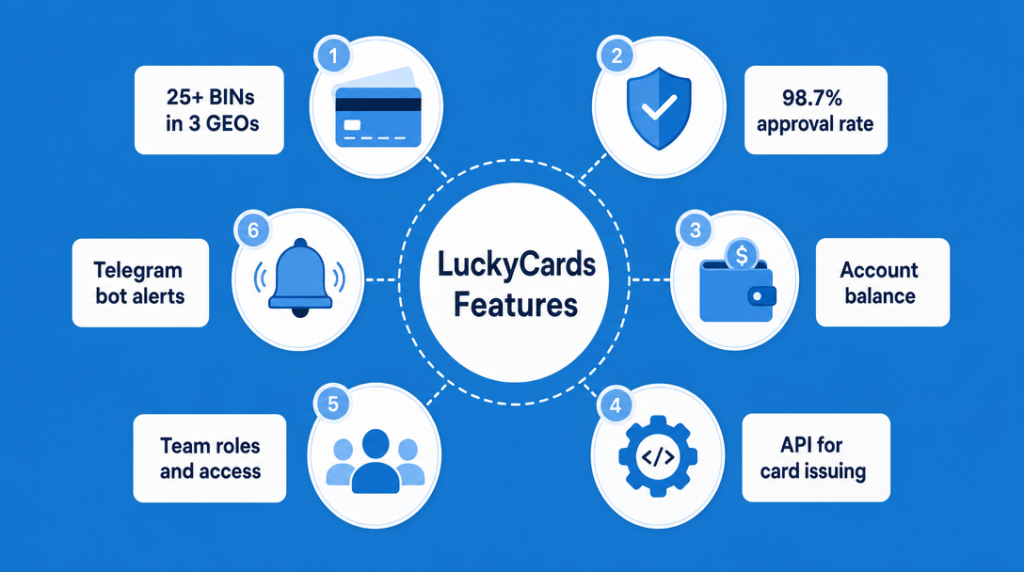
| Core features | 25+ BINs in 3 GEOs, account-balance cards, API for mass issuing and management, team roles and access levels, 3DS, Apple Pay / Google Pay, auto top-up, Telegram transaction bot |
| Pricing | From $1.5 per card issue, 3% top-up fee; $0 for declines, withdrawals and transactions |
| Onboarding | Manual verification with a short manager call, so BINs and GEOs are matched to your traffic from day one |
| Support | 24/7 Telegram support, personal account manager for onboarding and BIN selection |
| Highlights | Runs the internal payments of a 350+ buyer agency; compensation for issue cost if a card fails to attach; direct integration with the LuckyOnline affiliate network; referral program up to 35% revshare |
Pros and cons
Below is a condensed view of what LuckyCards does well and what to plan your workflow around. The points come from the declared feature set and pricing model.
Features and functionality
The functional core is built around three things: keeping cards alive on ad platforms, removing manual work from issuing, and giving team leads visibility over spend. Cards work with 3DS, Apple Pay and Google Pay, support auto top-up and bulk management, and cover 25+ BINs in three GEOs. Everything is available through the web dashboard, a Telegram bot and an API.
Account-balance cards. This is the headline mechanic. Spend is drawn from the shared account balance instead of a per-card wallet, so money does not sit frozen across a hundred cards and a campaign does not stall because one specific card ran dry. For teams running many accounts in parallel, this alone changes how treasury is handled.
BIN pool and pass rates
The declared figure is 98.7% of payments going through on FB, Google, TikTok, Taboola and MGID and other merchants. Behind it sits an issuer pool that gets refreshed regularly — the service adds one to two new issuers per quarter specifically to keep clean, fresh BINs in rotation rather than riding a single provider until it degrades.
Pass rates are monitored on the service side. If a provider starts failing, clients get moved to other BINs and expenses are compensated; if a card does not attach to an ad account at all, the issue cost is returned. There is precedent cited in the brief: when part of the BIN pool went out of circulation, the service compensated clients for card issue costs over that period. Practically, this means your BIN-testing routine can be lighter than usual, but you should still log which BINs perform best on your specific accounts and ask your manager for recommendations before a large flight.
API, team access and notifications
The API covers card issuing and management from your own systems, which is the difference between a farmer clicking through a dashboard for an hour and a script provisioning cards on demand. If you run automation around account farming or campaign launches, this is where LuckyCards fits into an existing stack rather than becoming another tab.
Team functionality adds roles and access levels for team leads and buyers, with all team cards managed from one account. The point is control without credential sharing — a buyer sees and spends only what they should, and the lead sees the full picture. A Telegram bot pushes transaction notifications, which works well as a real-time decline monitor during an active flight without anyone camping in the dashboard.
Funding and ecosystem. Top-ups go through USDT/USDC as well as WIRE/SEPA/ACH, with both dollar and euro accounts available. There is also direct integration with the LuckyOnline affiliate network: payouts can be received and the card balance topped up directly, which shortens the loop between earning and reinvesting into spend. Limits are described as high, and withdrawals carry no minimum and no fee. For exact limit values on your volumes, clarify with the support team.
Pricing and plans
LuckyCards does not use tiered subscription plans — you pay for card issuing and top-ups only, with no monthly maintenance on advertising cards. Issuing starts at $1.5 per card, the top-up fee is 3%, and declines, transactions and withdrawals cost $0. Teams with large volumes get individual terms.
| Item | Cost |
|---|---|
| Card issue | From $1.5 |
| Top-up | 3% |
| Declines | $0 |
| Transactions | $0 |
| Withdrawal | $0, no minimum |
| Maintenance (advertising cards) | $0 |
| Large volumes | Individual terms |
This model suits anyone whose card count fluctuates. A solo buyer issuing 20-30 cards a month pays only for what they actually create, and a team burning through several hundred cards per flight is not held back by a per-card subscription. The variable to watch is the top-up percentage, since at real volumes it is the line item that actually moves — which is exactly what the reader offer addresses.
Evaluation starts after a deposit, and if the service does not fit, funds can be withdrawn without additional fees. Registration includes manual verification: a short call with a manager, which also doubles as the moment to discuss your GEOs, merchants and expected volumes.
Who it suits best
LuckyCards is a fit for teams and solo buyers who spend on FB, Google, TikTok, Taboola and MGID and want cards that behave predictably, plus a fee structure with no hidden maintenance. The account-balance model and the API make it most valuable to anyone running cards at scale rather than a handful at a time.
Best fit scenarios. Media buying teams that need role-based access and one dashboard for all team cards; farmers and automation-heavy setups that provision cards through the API; solo arbitrageurs who want a low entry point at $1.5 per issue and no minimum withdrawal; and affiliates already working with the LuckyOnline network, who can route payouts straight into card balance.
What to clarify before you start. Onboarding includes a short manager call, so plan for a conversation rather than a blind signup — it is the fastest way to get the right BINs assigned. If you need a specific issuing country for an unusual merchant, check the current BIN list with your manager. And since evaluation begins after funding the account, the $100 minimum deposit works as a comfortable threshold for testing a funnel, with withdrawal carrying no extra fee.
Bottom line
LuckyCards positions itself as the internal card layer of a working media buying operation, opened to the market. That framing is the substance of the offer: 350+ buyers from the same group spend through these cards daily, so pass-rate problems hit the operator’s own budgets first, and compensation for failed issues and BIN migrations is part of the declared process rather than a goodwill gesture. Add account-balance cards, an API and team roles, and you get a tool aimed at volume.
For CPA.LIVE readers there is promo code LIVE50: 50 free cards and a 3% top-up fee locked in permanently, available until the end of September 2026. The rate is fixed at the moment you fund the account, with a $100 minimum deposit — so if the offer interests you, the deposit needs to happen within that window.
Support: @LuckyCards_Supp Account manager: @Aleksandra_LuckyCards Contact: @MariaLuckyCards Channel: @luckycards_info
FAQ
How do account-balance cards differ from regular per-card top-ups?
What happens if a card fails to attach to an ad account?
What if a BIN starts declining mid-flight?
How does evaluation work before committing budget?
What does the registration process involve?
Can I issue and manage cards outside the dashboard?
How does team access work?
Are there discounts for large volumes?
How does LuckyCards compare to other programs in the niche?
Is there a referral program?

Content verified by expert
On December 31, 2024, Dmitrii left his position as Head of Media Projects at ADSBASE Group. He currently leads CPA.LIVE and the ADDSET forum.
Holding numerous certificates, Dmitrii confirms his authority in digital marketing.

Ilya Sadowskiy Author
Creating social-media content since 2017. I write about arbitrage, marketing, IT, and crypto. I work with all text formats—from short Telegram posts to expert articles for major media outlets.