Mobile app affiliate programs look simple from the outside. Someone installs an app, you get paid. In practice the install is where the paperwork starts: the advertiser’s tracker decides whether it counts, a retention report decides whether it keeps counting, and a fraud check can take it back weeks later.
I’m Dmitrii, I run CPA.LIVE, and this is the guide I’d hand to anyone about to send their first traffic to an app or software offer. It covers how these programs pay, why installs get rejected, how software offers (antivirus, password managers, browser extensions) differ from mobile ones, and how to choose between a brand’s own program and a CPA network. In the middle there’s a snapshot of real mobile offers from a network offerwall, taken in October 2026, so the payout models don’t stay abstract.
Why mobile apps and software are a vertical of their own
Most verticals pay for one thing. A dating offer pays for a sign-up, a nutra offer pays for an order. App offers can pay for two quite different things, and sometimes the same app runs both.
The first is the install itself, paid as CPI. The second is something the user does inside the app: registers, starts a trial, buys a first subscription, makes a purchase. Subscription apps add one more layer. Some programs share revenue from renewals, so a user who keeps the app for a year keeps paying you long after month one.
Demand is global. Rates are not. The same app can pay several times more for a US install than for one from a market where people rarely pay for subscriptions, and iOS and Android installs inside one offer are often priced differently. Some networks skip the mixed offer entirely and list each platform as its own line.
Traffic rules are tighter than in many other verticals. Incentivized traffic, where the user gets a reward for installing, usually runs as a separate offer or isn’t allowed at all. Adult placements are almost always banned, and so is bidding on the brand name in search ads.
Then there’s the part that catches people coming from lead-gen: the advertiser sees what happens after the install. A dating lead is judged once. An app install keeps being judged for days. The advertiser watches whether users come back and whether they reach the in-app events that matter. A batch of cheap installs that nobody opens twice turns into a rejection report.
How mobile app and software affiliate programs pay
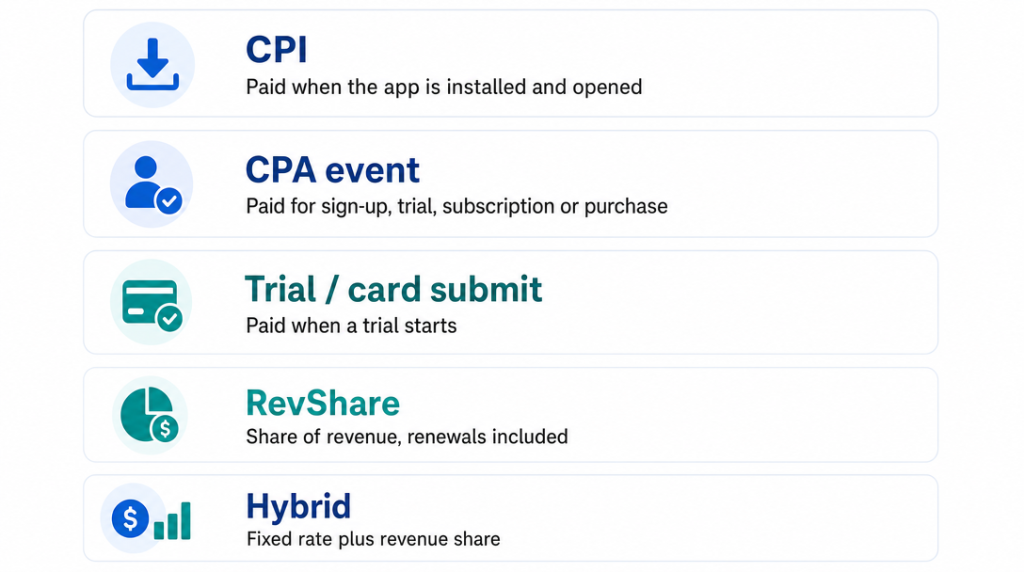
These are the payout models you’ll run into. App install offers, the classic CPI offers, are only the first row. Networks name the rest slightly differently, but the logic doesn’t change.
| Model | You get paid when | Typical fit | What can cut the payout |
| CPI (cost per install) | the app is installed and opened for the first time | utilities, games, apps with a free core | retention KPIs, install fraud checks |
| CPA for an event | the user registers, starts a trial, subscribes or buys | subscription apps, finance and service apps | lower conversion rate, longer validation |
| Trial or card submit | the user starts a trial, often with a card on file | subscription apps, desktop software | refunds and chargebacks |
| RevShare | the advertiser earns revenue from the user, renewals included | subscription apps, desktop software | slow cash flow, reliance on the advertiser’s reporting |
| Hybrid | a fixed rate plus a revenue share, or CPI plus an event bonus | larger subscription brands | the weak side of both parts |
Attribution: who decides that an install happened
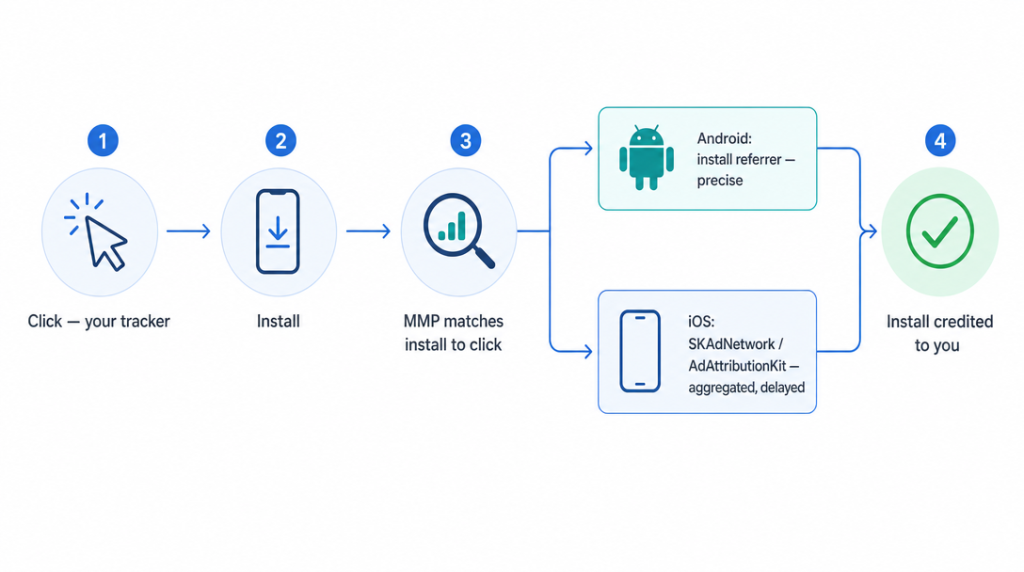
You don’t. The advertiser’s mobile measurement partner (MMP) does, usually AppsFlyer, Adjust or a similar service. Your tracker records the click. The MMP records the install and tries to match it to a click. If it finds no match, or credits the install to someone else’s click, there is no install for you, whatever your own stats say. Small gaps between your numbers and the network’s are normal. Large ones that keep growing are a question for your manager.
On Android the match is fairly precise, because Google Play passes an install referrer that ties the install back to the click.
iOS is messier. Since App Tracking Transparency arrived in 2021, installs from users who don’t allow tracking are attributed through Apple’s own frameworks, SKAdNetwork and the newer AdAttributionKit. That data comes in aggregated and late, sometimes days late. In practice your iOS stats fill in slower and with less detail than Android, which is worth remembering before you decide an iOS campaign “isn’t converting” after one afternoon.
What decides how much you actually earn
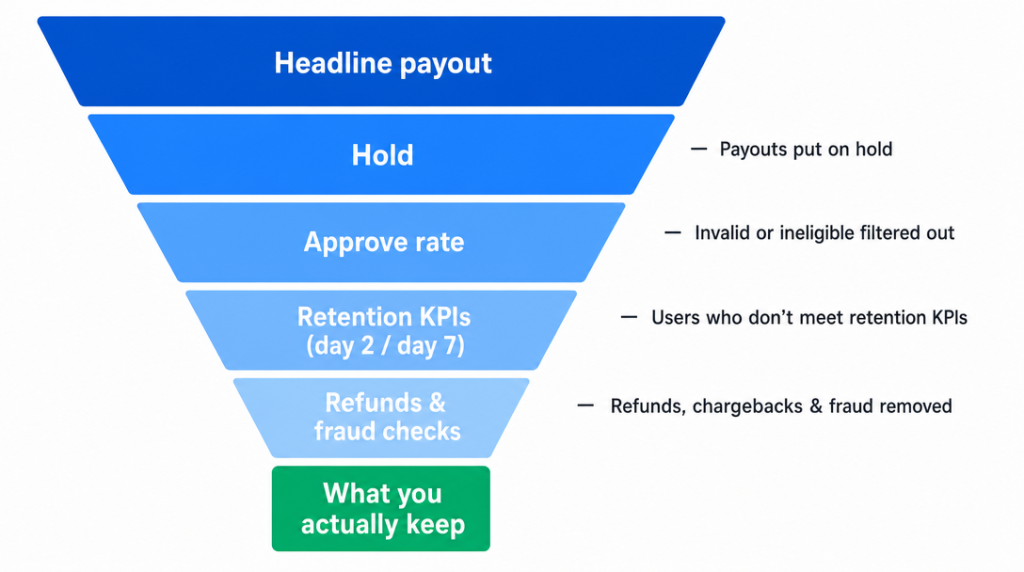
The rate on the offer card is a ceiling. What you keep depends on:
- hold, the period before your earnings become payable, which gives the advertiser time to check quality;
- approve rate, the share of conversions the advertiser confirms;
- retention KPIs, for example a minimum share of users who open the app again on day 2 or day 7;
- subscription refunds, which can land after the hold is over.
Then come the deductions. Refunds, chargebacks and installs flagged as fraud are taken back from the affiliate. MMPs look for a few familiar patterns: click injection (a malicious app on the phone fires a fake click a moment before an install finishes, to steal the credit), emulators that pretend to be phones, and device farms, racks of real phones installing apps on command. When a source gets flagged, the whole batch from it usually goes, good rows along with the bad.
So read the KPI and fraud terms before the first click, not after the first rejection. My own rule is blunt: if a source sells installs at a price that looks too good, the MMP will eventually agree that it was.
Best mobile app affiliate programs 2026: offers from a live catalog
Instead of a ranking built from press releases, here are mobile offers from the CIPIAI offerwall as of mid-October 2026. I kept to phone cleaners, utilities, subscription apps and one app that doubles as a browser extension. The offerwall opens after a quick sign-up, so you can check the current list yourself.
| Offer | What it is | Model | Payout* | GEO |
| iClixa: AI Phone Cleaner | phone cleaner | CPT (trial) | $9.20 | US |
| CleanControlSecureCleaner (iOS) | phone cleaner | CPT (trial) | $10.08 | AU, BR + 9 more |
| CleanControlSecureCleaner (iOS) | phone cleaner | CPI | $2.80 | AU, CA + 8 more |
| JourneyLensClean | phone cleaner | CPI | $3.20 | US |
| GeoFinder 1-Day Trial | phone locator app | CPA (trial) | $4.00 | AE, AU + 6 more |
| WalkFit | fitness subscription app | CPL | $8.00 | AT, AU + 8 more |
| Audiobooks.com | audiobook subscription | card submit | $6.00 | AU, CA + 2 more |
| Unest | investing app | CPA | $2.00 | US |
| Cash’em All | rewarded games app | CPA | $3.84 | US |
| Alerabat | coupon app and extension | CPI | $0.336 | PL |
*Payout as shown in the offerwall in October 2026. CPT means cost per trial: you’re paid when the user starts a trial. Card submit means the user enters card details to start one. CPL is a paid lead, usually a completed sign-up or onboarding quiz. Rates, caps and GEO lists change often, so check the offer page and its KPI terms before you launch.
Two things in this list are worth a closer look.
The first is the iOS cleaner that appears twice: $2.80 per install, or $10.08 per trial. That one app is the whole CPI-versus-CPA question in two rows. The trial version pays more because the advertiser only pays for users who have already shown they’re willing to pay. The risk that someone installs and wanders off moves from the advertiser to you.
The second is that the payout column is the wrong place to start reading. Start with GEO. A $9 trial offer that takes only US traffic and a $3 install offer open in ten countries are two different businesses, and which one is “better” depends on where your traffic actually comes from.
Software affiliate programs: antivirus, password managers, extensions
Software offers share a lot with apps (subscriptions, trials, quality checks), but the purchase happens in a different place. It’s usually a desktop sale, and the payout model is closer to classic CPA, per sale or per trial. People take longer to decide, and more of them ask for their money back in the first 30 days.
The difference in buying behaviour is easy to picture. Someone clearing space on a phone installs a cleaner in seconds. Someone choosing antivirus for the family laptop reads a couple of reviews, compares prices and may wait for a discount.
Antivirus
Antivirus is mostly sold as an annual subscription, by well-known brands, to people with a clear goal: protect the device. That intent lives on review and comparison sites, in search and in email, which is why those are the sources these programs prefer. Because you’re paid for a year of subscription, per-sale payouts run far above install offers. In the same offerwall, antivirus sales paid tens of dollars while most mobile installs paid single digits. The catch is refunds. Many vendors offer a money-back window, and a refund inside it takes your commission with it.
Password managers and browser extensions
These pay either per installed extension or per subscription. Traffic comes from reviews, niche blogs and placements inside other apps. Extension installs pay little per unit (the coupon extension in the table above earns a fraction of a dollar), so this is a volume game, or a long-tail content game where one solid comparison page keeps sending installs for months.
Other desktop tools
Cleaners and optimizers, backup and data recovery tools, office suites and AI productivity apps fill out the rest of most software catalogs. They tend to run on RevShare or on low-rate CPI with very wide GEO lists, some of them open in 200+ countries. That suits content sites with international traffic. It suits paid campaigns that need a high payout per conversion much less.
Direct program or CPA network: choosing the best affiliate network for tech offers
Sooner or later everyone in this vertical asks whether to go to the brand directly or through a network. Both can work. They fit different situations.
A direct program gives you the terms first-hand and a direct line to the advertiser. It also gives you one offer, a stricter approval process and a separate payout from every brand you work with. With mobile app affiliate programs there’s a more basic problem: many app brands don’t run one for individual affiliates at all and buy traffic only through networks or agencies.
A CPA network gives you many offers under one account, one payout, a manager, and a replacement offer when a brand closes its program or runs out of cap. In tech verticals, where offers appear and disappear quickly, that last part matters more than it looks.
When comparing networks, these are the questions worth asking before you sign up:
- How deep is the catalog in your vertical? A huge offerwall where mobile is a side section helps less than a smaller one built around apps and software.
- Are hold and approve rate stated openly, and is there a record of the network paying on time?
- Does it support postbacks to your tracker (Keitaro and others)? For mobile offers, how does it pass on data from the advertiser’s MMP, including rejections by KPI?
- Which traffic sources are allowed, is that written down per offer, and are incent and non-incent kept apart?
- What are the daily install caps, and what happens to traffic that arrives after a cap is hit?
- How does the network tell you an offer has closed, and what does it suggest instead?
- How fast does the manager actually reply?
The last three answers tell you more than the payout column. A network that replies quickly and warns you before an offer dies saves you more than an extra dollar per install.
CIPIAI, the network whose offerwall I used for the table above, is built around this niche: it’s a CPA network focused on Mobile, Extensions and Software. The practical upside shows in the table itself. Similar products run under different models side by side (install, trial, in-app event, revenue share), so you can test which one fits your traffic without moving to another network. Put it through the same checklist as any other network, starting with the KPI terms and caps of the offers you plan to run.
Before you send the first click
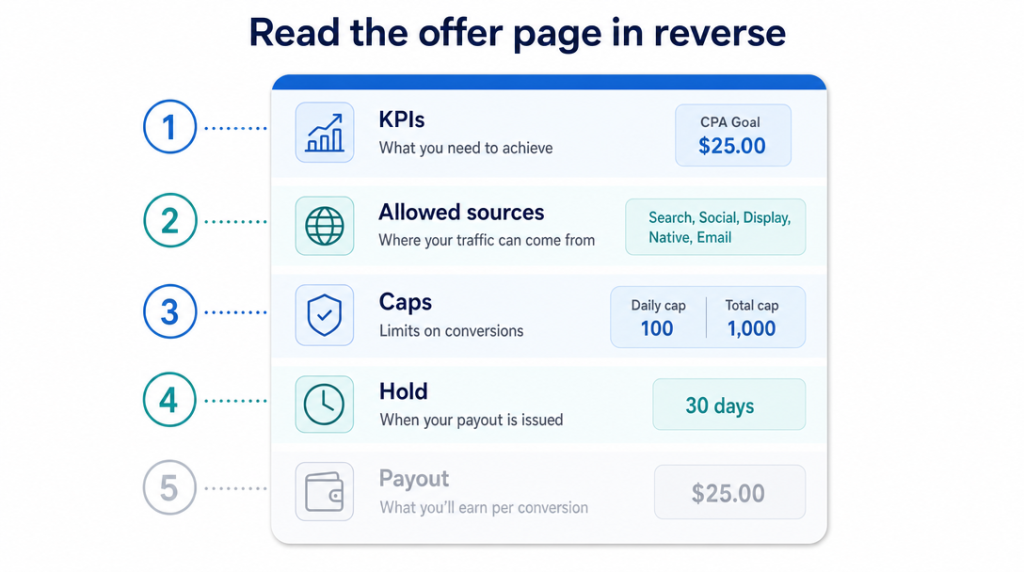
If I had to squeeze all of this into one habit, it would be reading an offer page in reverse order: KPIs, allowed sources, caps and hold first, payout last. The payout is what you could earn. The rest of the page decides how much of it you keep.
FAQ
Which mobile app affiliate program pays the most?
What is the difference between CPI and CPA app offers?
Is it better to join an app brand directly or via a CPA network?
What traffic sources are allowed for mobile app offers?
How long is the hold on app install payouts, and why do installs get rejected?

Content verified by expert
On December 31, 2024, Dmitrii left his position as Head of Media Projects at ADSBASE Group. He currently leads CPA.LIVE and the ADDSET forum.
Holding numerous certificates, Dmitrii confirms his authority in digital marketing.
Dmitrii Medvedko Author
An expert deeply immersed in the affiliate industry. She has managed media projects such as CPA Mafia, CyberAff, ProTraffic, AffTimes, CPA Monstro, and Affiliate Valley, and gained hands-on experience in the nutra segment through the WebVork affiliate network.