Push notifications still convert in 2026 — but only if you know which networks have real subscribers and which are reselling tired bot traffic. If you’re a media buyer or affiliate eyeing push advertising as a fresh channel for nutra, finance, gambling or sweepstakes offers, this guide cuts through the noise.
You’ll get a straight answer on what push traffic actually is in 2026 (in-page vs. classic, mobile vs. desktop), realistic CPC ranges by GEO, the seven networks worth your test budget, and the targeting setups that separate a $50 burn from a 200% ROI campaign. No fluff, no recycled 2022 screenshots — just what works right now.
Let’s start with what push advertising looks like today, because the format has changed more than most blogs admit.
Key Takeaways
- Push CPC in 2026 ranges from $0.001 in Tier 3 GEOs (India, Indonesia, Vietnam) to $0.50+ for Tier 1 iGaming, with most networks requiring a $50-$150 minimum deposit to start.
- Classic web push delivers 0.3-1.2% CTR but skips iOS Safari entirely; in-page push reaches iOS and bypasses AdBlock at 0.1-0.4% CTR and costs 20-40% more.
- Top push networks for 2026 include RichAds and EvaDav for beginners ($100 deposit, clean dashboards), PropellerAds for raw volume (5B+ daily impressions), and ROIads as an iGaming specialist.
- Targeting subscribers in their first 3-5 days after opt-in can lift CTR 3-5x versus older lists, and splitting mobile and desktop into separate campaigns prevents the optimizer from killing your winning device.
- A realistic first test runs $300-500 across two networks on Tier 2 Sweepstakes or Dating offers at $0.01-$0.025 CPC, with a tracker like Voluum or Binom catching bot traffic flagged by CTR above 5% or zero scroll depth.
What Push Advertising Actually Is
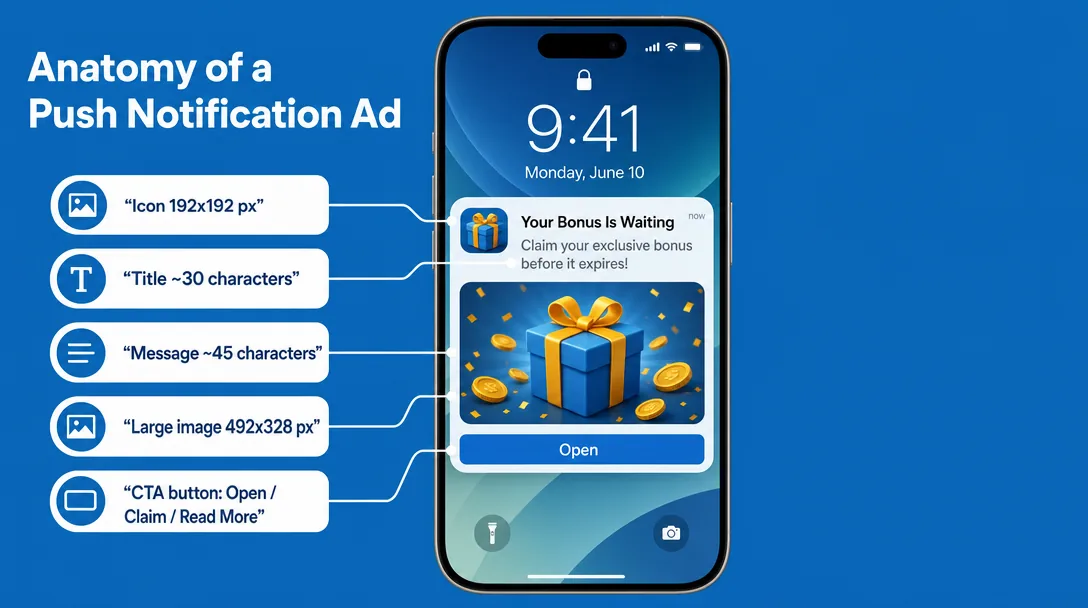
You’re scrolling Twitter on your phone when a small notification slides down from the top: a square icon, a punchy headline like «Your Bonus Is Waiting,» one line of copy, and a tap-ready CTA. That’s a push ad — and someone just paid a few cents for it to land in front of you.
Push advertising is a paid traffic channel built on clickable, system-level notifications delivered to users who previously clicked «Allow» on a publisher’s site. The ads appear outside the browser window — on the lock screen, in the notification tray, or as a desktop pop-up — which is why they sit on top of whatever else you’re doing.
Here’s how the opt-in subscription flow works. A user visits a publisher’s site (news, streaming, file-sharing), sees a browser prompt asking permission to send notifications, and clicks Allow. That subscriber is added to the ad network’s database. From that moment, the network can deliver push notification ads to that device until the user unsubscribes or clears their browser data.
The anatomy of a single push ad is tight by design:
- Icon: 192×192 px square, usually a logo or face
- Title: ~30 characters, the hook
- Message: ~45 characters, the promise or curiosity gap
- Large image (optional): 492×328 px on most networks, mobile-dependent
- CTA button: «Open,» «Claim,» «Read More»
One distinction trips up beginners: push ads are not the same as transactional push notifications. Transactional pushes come from apps or sites where you’re already a user — your bank confirming a transfer, Uber telling you the driver arrived. Push ads are paid media bought from a network, served to that network’s subscriber pool, and billed on a CPC pricing model.
Why advertisers keep coming back: every impression is a human who consented to receive notifications, the format bypasses ad blockers entirely, and the placement is impossible to ignore without a deliberate swipe.
Classic Web Push vs In-Page Push vs Mobile Push
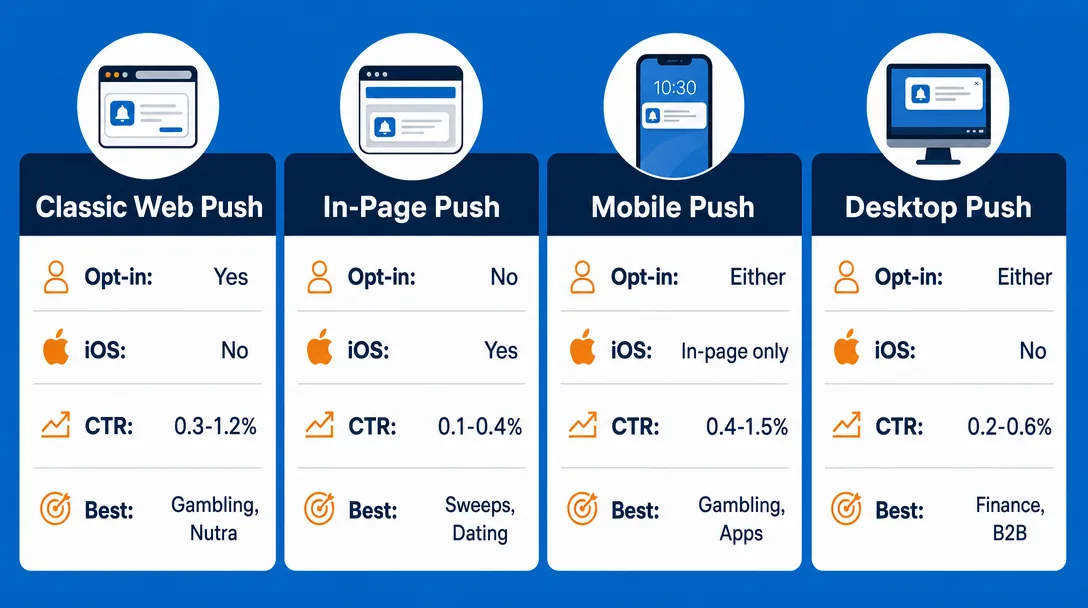
Format choice is the first lever that moves your CPC, reach, and creative angle — not the network, not the GEO. A classic web push at $0.008 in Tier-3 behaves nothing like an in-page push at $0.004 on the same offer, because the audience, the moment, and the visual frame are different. Pick the wrong format and your pre-lander logic falls apart before you even touch bids.
Classic web push. This is the original format: a user visits a publisher site, sees an opt-in prompt («Allow notifications?»), clicks Allow, and from that moment lands in the subscriber database. Ads are then delivered through OS-level notifications — Windows action center, Android notification tray, macOS banners — even when the browser is closed. Because the user opted in, intent is higher and CTR sits in the 0.3–1.2% range. The trade-off: no iOS Safari support, and database freshness matters a lot (subscribers older than 30 days convert worse).
In-page push. This format looks identical to a classic notification, but it lives as a banner inside the website itself. No opt-in, no subscriber list — it’s served to anyone visiting a partner publisher. That unlocks iOS, Safari, and AdBlock bypass, which roughly doubles addressable inventory. The downside is intent: users didn’t ask for notifications, so CTR usually lands at 0.1–0.4% and you’ll see more accidental clicks. Great for top-of-funnel volume on Sweepstakes, Dating, and Nutra; weaker for high-ticket verticals.
Mobile vs desktop push. Mobile push covers about 80% of screen real estate, supports GPS-level GEO targeting, and dominates Gambling, Dating, and Sweeps. Desktop push has smaller reach but stronger purchase intent — it wins for B2B SaaS, crypto, forex, and finance offers where the buyer is working at a computer with a credit card nearby.
| Format | Opt-in? | iOS support | CTR range | Best verticals |
|---|---|---|---|---|
| Classic web push | Yes | No | 0.3–1.2% | Gambling, Nutra, Finance |
| In-page push | No | Yes | 0.1–0.4% | Sweeps, Dating, Utilities |
| Mobile push | Either | In-page only | 0.4–1.5% | Gambling, Dating, Apps |
| Desktop push | Either | No | 0.2–0.6% | Finance, B2B, Crypto |
Rule of thumb. Test classic web push first for warm verticals with clear payout (Gambling, Nutra). Layer in-page push when you need iOS reach or want to scale Sweeps. Split mobile and desktop into separate campaigns — never mix them in one bid.
On my own runs I learned the hard way to never mix mobile and desktop in one campaign. Last spring I had a sweeps offer in Brazil where mobile was pulling 0.9% CTR at $0.012 and desktop was a flat 0.2% at the same bid — when they sat in one campaign the optimizer kept feeding desktop and the whole thing looked like a loser. Split them, killed desktop, mobile went to 180% ROI inside three days. Same story shows up every time on Gambling LATAM.
Real 2026 Costs: CPC Benchmarks by Tier and Vertical
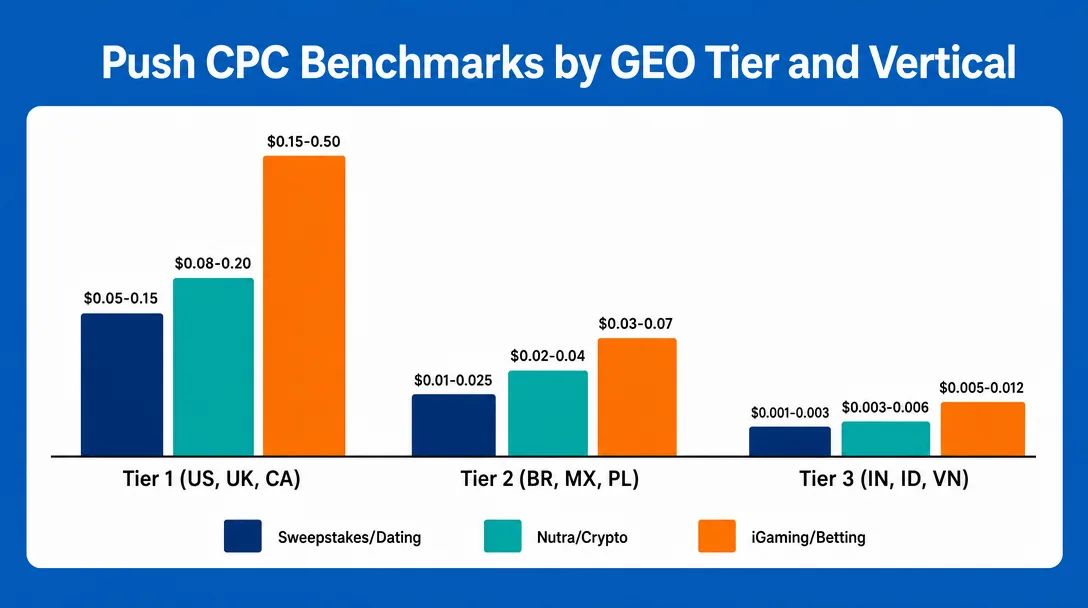
Push advertising runs almost entirely on CPC pricing, with cost per click ranging from $0.001 in Tier 3 to $0.50+ for premium Tier 1 placements. CPM is offered as an alternative on most networks (useful when CTR is unpredictable), and a handful of platforms support CPA goals once you’ve burned through enough test data to optimize.
Here’s what you’ll actually pay to buy push traffic in 2026:
| GEO Tier | Sweepstakes / Dating | Nutra / Crypto | iGaming / Betting |
|---|---|---|---|
| Tier 1 (US, UK, CA, AU, DE) | $0.05–$0.15 | $0.08–$0.20 | $0.15–$0.50 |
| Tier 2 (BR, MX, PL, ES, IT) | $0.01–$0.025 | $0.02–$0.04 | $0.03–$0.07 |
| Tier 3 (IN, ID, VN, PH, NG) | $0.001–$0.003 | $0.003–$0.006 | $0.005–$0.012 |
The Tier 1 vs Tier 3 spread is roughly 50x at the floor — which is why budget testing in cheap geos is standard practice before scaling to expensive markets. Tier 1 buyers pay a premium for purchasing power, not click quality.
Vertical multipliers stack on top of GEO. iGaming and Betting carry a 30–50% premium because LTV is high and competition for subscribers is brutal. Nutra and Crypto sit mid-range. Sweepstakes, Dating, and Utilities are the cheapest verticals to test on because they convert on first impression and don’t require deep funnels.
In-page push (the format that bypasses AdBlock and reaches iOS users) typically runs 20–40% above standard browser push because inventory is smaller and engagement is higher.
Minimum deposits to start buying:
- RichAds, Adsterra, PropellerAds: $100
- EvaDav, MGID, Clickadu: $100–$150
- DSP programmatic platforms (TrafficStars, Zeropark enterprise): $250–$500
A realistic starter math: take a $500 budget, split it across two Tier 2 geos in a Sweepstakes campaign at $0.02 average CPC. That’s 25,000 clicks — enough volume to identify 3–5 winning creative-source combos and kill the rest. Push the same $500 into US iGaming at $0.30 CPC and you get 1,666 clicks, which is barely enough to validate one creative.
The lesson: match your budget to your geo. Start in Tier 2 or Tier 3, gather data, then scale to Tier 1 with proven creatives and pre-landers.
Top 12 Push Ad Networks Compared
Across the major push ad networks in 2026, three things actually differentiate them: traffic volume, vertical fit, and how aggressively they filter bot traffic. The table below lines up all twelve on the metrics that matter before you fund an account.
| Network | Min Deposit | Daily Impressions | Pricing | Top GEOs | Top Verticals | Anti-Fraud | Standout |
|---|---|---|---|---|---|---|---|
| RichAds | $150 | 5B+ | CPC, CPM | US, BR, IN, ID | Gambling, Nutra, Sweepstakes | Adscore, in-house | Micro-bidding by source ID |
| PropellerAds | $100 | 5B+ | CPC, CPM, SmartCPM | Tier 1-3, global | Sweeps, Finance, Utility | In-house + third-party | Largest subscriber base |
| Adsterra | $100 | 1B+ | CPC, CPM, CPA Goal | 248 GEOs | Software, Dating | In-house Anti-Fraud | Social Bar in-page push |
| Mobidea Push | $100 | 800M+ | CPC | LATAM, EU, SEA | Dating, Sweeps, Nutra | Internal scoring | Mobile-first inventory |
| EvaDav | $100 | 2B+ | CPC, CPM, CPA | US, IN, BR, DE | Gambling, Dating, Crypto | Adscore partner | Audience retargeting |
| RollerAds | $100 | 1B+ | CPC, SmartCPC | US, BR, ID | iGaming, Nutra, Finance | In-house | OnClick + push combo |
| Clickadu | $100 | 4.5B+ | CPM, SmartCPM, CPC | Global | Adult, Gaming, Dating | In-house + Forensiq | Strong adult inventory |
| PushGround | $100 | 600M+ | CPC | EU, US, CA | Sweeps, Dating, Nutra | Internal filters | Clean European traffic |
| ROIads | $250 | 300M+ | CPC | Tier 1, CA, NZ | iGaming exclusive | Manual + automated | iGaming specialist |
| MGID | $100 | 850M+ (native+push) | CPC, CPM | US, EU, APAC | Finance, Health, Tech | Brand-safety stack | Native + push blend |
| AdMaven | $50 | 2B+ | CPC, CPM, CPA | Global | Utility, Adult | In-house | Lowest entry cost |
| HilltopAds | $50 | 73B monthly | CPM, SmartCPM | Global | Gambling, Adult, Apps | In-house + GeoEdge | High-volume CPM bidding |
Honest read on each network
RichAds. Built for affiliates who want granular control. The micro-bidding tool lets you adjust bids per source ID, which is rare at this volume. Weakness: the $150 minimum and a learning curve on the optimization rules. Best fit for buyers running Gambling and Sweeps in Tier 1-2 who already know how to whitelist sources.
PropellerAds. The volume leader. If you need scale fast in any GEO, this is the first stop. SmartCPM auto-bidding works well for buyers who don’t want to babysit campaigns. Weakness: traffic quality varies widely by source, so manual whitelisting is non-negotiable. Good for utility offers, sweeps, and high-funnel pushes.
Adsterra. Strong on geographic reach and the Social Bar format, which is technically in-page push but gets push-level CTR. Weakness: push volume is smaller than the headline numbers suggest because Social Bar dominates inventory. Best for software and dating offers needing 200+ GEOs.
Mobidea Push. Mobile-heavy inventory and tight integration with the Mobidea affiliate ecosystem. Weakness: lower volume in Tier 1, weaker for desktop offers. Fits LATAM and Southeast Asia dating and sweepstakes campaigns.
EvaDav. Solid all-rounder with one of the better retargeting tools among self-serve platforms. Push, in-page, and native under one dashboard. Weakness: support response times can lag during EU off-hours. Works well for gambling and crypto offers in Tier 1-3.
RollerAds. Combines push with OnClick, which makes sense for buyers running pop and push side by side. Weakness: dashboard feels dated. Good for iGaming and finance buyers who want one billing relationship.
Clickadu. Push and pop powerhouse, strongest in adult and gaming. Weakness: not the place for clean-vertical buyers running pharma or finance.
PushGround. Smaller but cleaner European inventory. Weakness: limited volume outside EU. Good for buyers prioritizing quality over scale.
ROIads. iGaming specialist with hand-curated subscriber lists. Weakness: $250 minimum and narrow vertical focus. Worth it if iGaming is your only play in Tier 1.
MGID. Native-first platform with push as a secondary format. Weakness: push volume is modest. Fits buyers who want native and push from one dashboard for finance and health.
AdMaven. $50 entry makes it the easiest place to test push. Weakness: traffic quality requires aggressive filtering. Decent starter network.
HilltopAds. Massive CPM-based inventory with SmartCPM bidding. Weakness: less suited to CPC-focused performance buyers. Strong for gambling and adult at scale.
How to Pick a Push Network: A Scoring Checklist
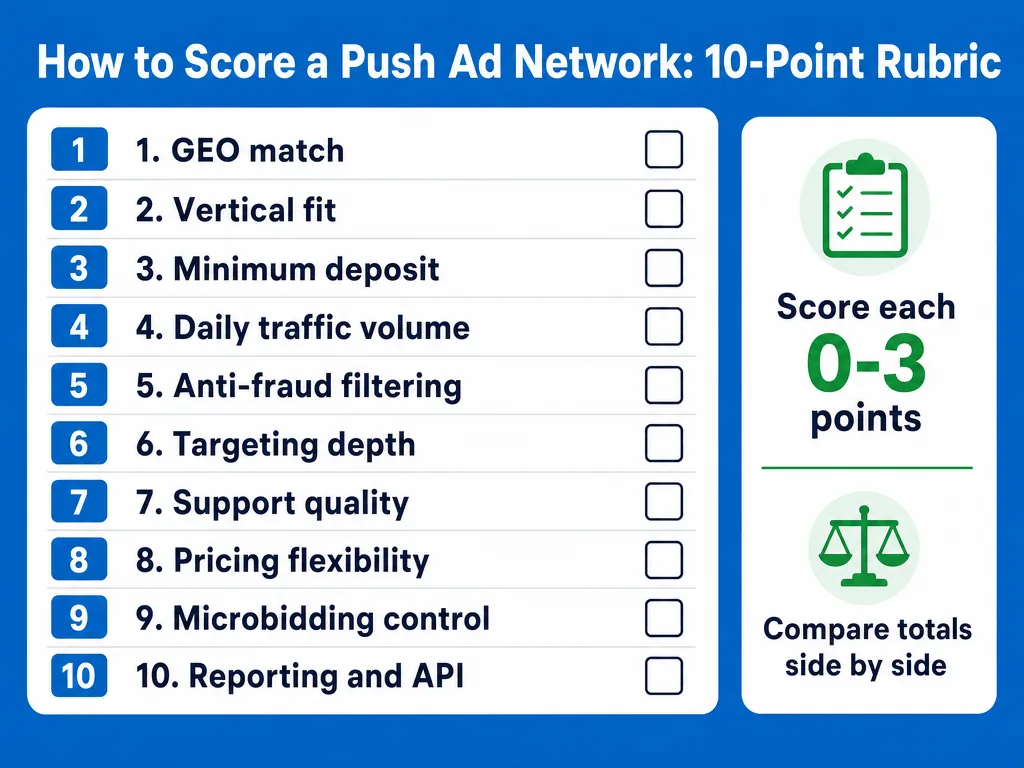
Most «best push networks» roundups just dump a list and call it a day. That’s useless when you’re deciding where to drop your first $500. Score networks against your actual case — GEO, vertical, budget — and the shortlist gets honest fast.
Run every candidate through this 10-point rubric. Give each item 0-3 points, then compare totals side by side.
- GEO match — does the network have real volume in your target countries, not just a flag on the homepage?
- Vertical fit — Gambling, Nutra, Dating, Sweepstakes, Crypto: ask which verticals their subscriber database converts on.
- Minimum deposit — under $100 is friendly for testing; $500+ signals they want bigger spenders.
- Daily traffic volume — impressions per day in your GEO, not global totals.
- Anti-fraud filtering — what’s the stack? SubID-level blocking, bot detection, third-party verification?
- Targeting depth — OS, browser, connection type, subscriber age (days since opt-in), device price tier, microbidding on source ID.
- Support quality — response time on a test ticket before you deposit. Two hours vs two days tells you everything.
- Pricing flexibility — CPC, CPM, SmartCPC, CPA goal. More models = more room to optimize.
- Microbidding and source-level control — can you raise or cut bids on individual zones, or only on the campaign level?
- Reporting and API — granular stats by hour, source, creative, plus API access for trackers like Keitaro or Voluum.
Self-serve vs managed vs DSP. Self-serve platforms (RichAds, PropellerAds, EvaDav) suit anyone who wants to launch in an hour and iterate fast. Managed accounts make sense for $5k+ monthly budgets where a manager handles whitelists. A push DSP fits teams running programmatic across multiple supply sources with their own bidding logic.
Red flags. Networks that refuse small trial budgets, hide subscriber stats, won’t disclose their anti-fraud approach, or have no public case studies. Walk away — independent network reviews are worth checking before you deposit.
Starter combo. Run two push ad networks in parallel with identical creatives and offers for 7-10 days. You’ll learn more from that A/B than from any review article — including this one.
Best Verticals and GEO Pairings for Push in 2026
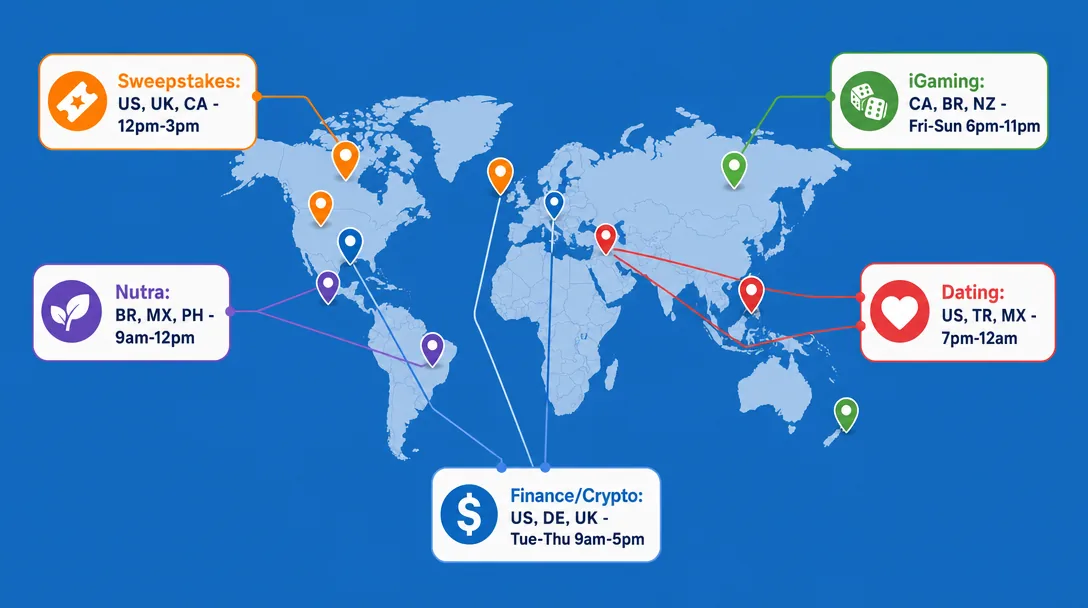
The vertical you run and the GEOs you target are a single decision, not two — a winning offer in the wrong country burns budget just as fast as a weak creative in the right one. Push rewards specific pairings, and the gap between a profitable combo and a losing one is usually geography plus send time, not the offer itself.
Sweepstakes stays the entry drug for new buyers. Tier 1 (US, UK, CA, AU) eats SOI and DOI flows, creatives cost almost nothing to test, and payouts clear fast enough to learn what works inside a week.
iGaming and betting perform best where the market is regulated and players are used to bonus offers — Canada, New Zealand, Australia, Brazil — plus Tier 2 Europe (PL, DE, PT). Push lets you hit registered-but-inactive audiences and weekend deposit cycles without competing head-to-head with Meta CPMs.
Nutra is the volume play across Tier 2 and Tier 3 (LATAM, SEA, parts of EMEA). Weight loss, joints, male enhancement, and skin angles convert on broad demographics, but compliance is the catch — networks reject «before/after» shock creatives, and Tier 1 traffic sources have tightened health-claim language. Stick to softer hooks.
Dating is a mobile-first, evening-hours vertical. Tier 1 mainstream works for SOI; Tier 2 (TR, MX, BR, IN) runs adult angles at lower CPCs. Send between 7pm and midnight local time and you’ll see CTR jump 30-40% versus daytime windows.
Finance and crypto flip the device pattern — desktop push outperforms mobile because the audience makes investment decisions on a laptop. Tier 1 CPCs run premium ($0.15-0.40), but trader signups and broker leads justify it.
E-commerce and direct brands are the overlooked use case. If you own a Shopify store or DTC brand, web push is a retargeting channel — abandoned cart recovery, restock alerts, flash-sale pushes to your own subscriber database. Most affiliate guides skip this entirely, which means CPMs stay reasonable.
| Vertical | Top 3 GEOs | Best send window |
|---|---|---|
| Sweepstakes | US, UK, CA | Weekday 12pm-3pm |
| iGaming | CA, BR, NZ | Fri-Sun, 6pm-11pm |
| Nutra | BR, MX, PH | Weekday 9am-12pm |
| Dating | US, TR, MX | Daily 7pm-12am |
| Finance/Crypto | US, DE, UK | Tue-Thu, 9am-5pm |
| E-com retargeting | Your customer base | Within 24h of cart abandon |
GEO targeting plus the right send window often moves ROI more than swapping the creative.
Compliance: GDPR, Chrome Rules, and the iOS/Safari Problem
Most push guides skip this part. Read it before you push spend past five figures a month — the difference between a network with clean inventory and one full of dark patterns shows up fast in compliance fines and refused payouts.
The GDPR and CCPA basics. Opt-in must be explicit. A pre-prompt that says «Click Allow to continue» is not consent — it’s a dark pattern, and EU regulators have started treating it as a GDPR violation. Subscribers need a clear unsubscribe path (one click from the notification, plus browser-level controls), and data retention has to be documented: how long you store the subscriber token, what you do when someone unsubscribes, who has access. If you’re buying traffic, you’re not directly liable for how the network collected subscribers, but advertisers have been pulled into investigations. Ask the network for their consent flow before you scale.
Chrome’s quieter UI. Since 2020, Chrome auto-mutes notification prompts on sites that get high block rates. The prompt becomes a tiny bell icon in the address bar — invisible to 95% of users. This is why subscription rates on Chrome have dropped sharply on aggressive sites. Networks with clean opt-in flows hold steady; spam farms have been hit hard. When you buy push traffic, you’re inheriting whatever subscription quality the network built. Old, low-engagement subscribers fill up databases but don’t convert.
The iOS Safari problem. Web push doesn’t work in Safari on iOS the way it does on desktop or Android. Since iOS 16.4 (March 2023), Apple only delivers web push to sites that users install to their home screen as a PWA push — meaning the user has to tap Share, then «Add to Home Screen,» then opt in. Almost nobody does this. Classic push networks effectively have zero iOS Safari reach.
Workarounds that actually work. In-page push (banners that mimic notifications, served on-site) runs fine on iOS Safari — ask networks for their iOS share. Mobile app SDK push reaches iOS users inside apps. For desktop campaigns, Safari users on macOS still receive standard web push. If your offer skews iOS-heavy (Dating, US Sweepstakes, premium Nutra), build the media plan around in-page push and app inventory, not classic web push. Demand iOS share numbers from any network before signing a deposit.
Launching Your First Push Campaign Step by Step
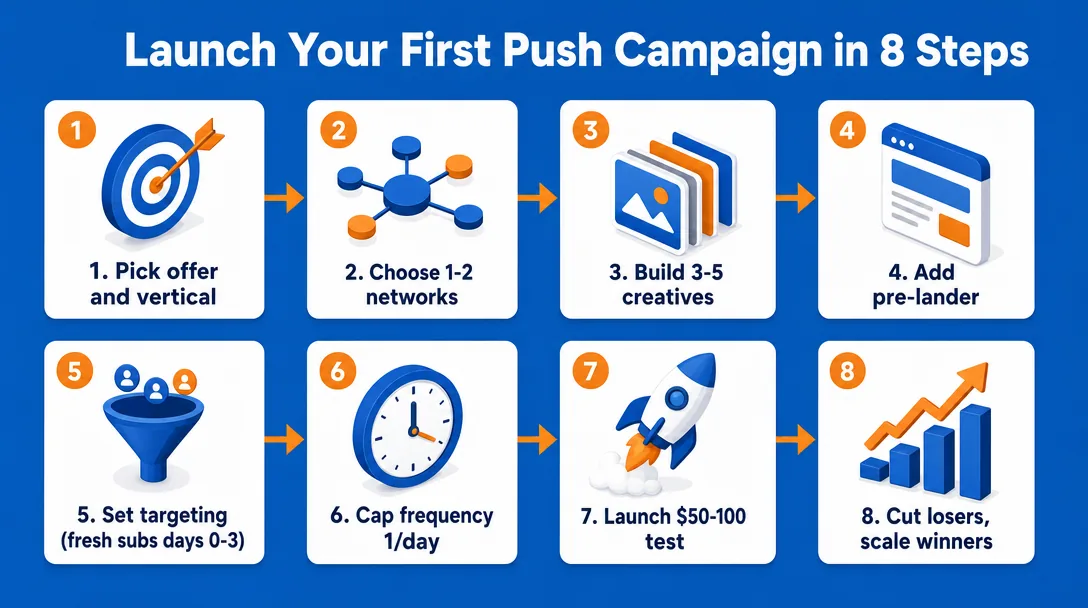
Your first push campaign goes from picking an offer to scaling winners in eight steps. The full loop — offer selection, network setup, creatives, pre-lander, targeting, test budget, optimization — fits into 48-72 hours if you stay disciplined. Here’s the exact sequence that works for media buying in 2026.
- Pick offer and vertical. Match the offer to your budget and GEO experience. New buyers with $200-500 should start with Sweepstakes or Dating in Tier-2 GEOs (Brazil, Indonesia, Philippines) — payouts are $1-5, so you get statistical significance fast. Gambling and Nutra need $1,000+ to test properly. Browsing curated affiliate programs before you commit saves a lot of guesswork on payout terms.
- Choose 1-2 networks and fund the minimum deposit. Stick to two ad sources max for your first run, otherwise you’ll split data too thin to read results. Most networks ask for $50-100 to start.
- Build 3-5 creative variants. Each ad creative needs three parts: icon (face, emoji, or product shot), title hook (5-7 words), and message (one short benefit line). Test curiosity («She didn’t expect this…»), numbers («3 ways to earn $200/day»), and urgency («Last 12 spots in your city») against each other.
- Build or grab a pre-lander. A pre-lander warms up cold traffic and lifts conversion 2-4x. Pull a proven template from your network’s library or SpyPush, then customize the angle to match your creative.
- Set targeting. Lock in GEO, OS, browser, and connection type. Critical move: target fresh subscribers from their first 3-5 days in the database — CTR runs 3-5x higher than on older lists. If you’re running multi-account or need to bypass platform IP restrictions during setup, mobile proxies are the cleanest workaround.
- Cap frequency at 1 impression per user per day. This protects your budget during testing. You can raise it later for winners.
- Launch with a $50-100 test budget and watch 24-48 hours. Don’t touch the campaign in the first 6 hours — push needs delivery to stabilize. After day one, you should have enough clicks per creative-placement combo to judge.
- Cut losers, scale winners with microbidding. Kill creatives below half the average CTR and blacklist placements with zero conversions after 2x payout spent. On winners, raise bids 15-30% on top sources via microbidding to grab more volume.
The fresh-subscribers trick in step 5 is the single biggest unlock I tell new buyers about. On a dating offer in Turkey I was getting 0.4% CTR on the default audience — switched the segment to subscribers in days 0-3 and CTR jumped to 1.6% overnight, same creatives, same bid. The catch is volume drops 4-5x, so you have to scale across more sources to keep delivery up. Worth it every time for the first 2 weeks of a campaign.
Refresh creatives every 2-3 days. Push ads burn out fast — CTR drops 30-50% by day four on the same audience, so keep new hooks in the pipeline.
Tracking, Attribution, and Catching Fraud
Push advertising sends huge click volume at low CPCs, which means a single misconfigured campaign can burn $200 in an afternoon without you noticing. A tracker is non-optional — it ties every click to a creative, source ID, and GEO so you can kill losers within hours, not days.
The standard stack is Voluum, Binom, RedTrack, or Keitaro. Voluum is cloud-based and easiest for solo buyers; Binom and Keitaro are self-hosted and cheaper at scale; RedTrack sits in between. Setup is the same idea everywhere: build a campaign URL with tokens for campaign ID, source/publisher ID, GEO, device, and creative ID. Most push networks pass these automatically through macros like {campaign_id}, {source}, {creative_id}.
Postbacks close the loop. Your affiliate network fires a postback URL to the tracker when a conversion happens — usually something like https://yourtracker.com/postback?cid={click_id}&payout={payout}. Without postbacks you’re flying blind on which source ID actually converts.
Fraud red flags to watch in your tracker reports:
- CTR above 5% on a cold offer (real push CTR sits around 0.3-1.5%)
- Hundreds of clicks with zero scroll, zero form interaction, zero time-on-page
- 95%+ of traffic from a single device model or OS version
- Click timestamps clustered within milliseconds of each other
- A source ID with massive volume but conversion rate near zero
Networks layer their own anti-fraud filtering on top. RichAds runs AdScore, Pushground uses Opticks, and most mid-tier networks have in-house ML bot filtering. None of it is perfect — that’s why your tracker is the second line of defense.
Before you commit budget, vet the network’s subscriber database. Ask three questions: How recent is the average subscriber (anything over 60 days is stale and underperforms)? Can you get a whitelist of publishers other buyers run profitably on the same vertical? And run a $50-100 test on a small GEO before scaling — if numbers in your tracker don’t match the network dashboard within 10%, something is off.
Bottom Line
Push traffic in 2026 still works — it’s just stricter and more fragmented than it was three years ago. Web push leans hard on Tier-2 and Tier-3 GEOs where CPCs sit at $0.003–$0.02, in-page push picks up the slack on iOS and Safari, and mobile push delivers the cleanest engagement when you can get it. The winning playbook hasn’t changed much: pair the right format with the right GEO, test 2-3 networks side by side, watch for bot traffic on day one, and stay clean on GDPR and Chrome’s notification rules.
Pick two networks from the comparison table, deposit the minimum on each ($50–$100 is usually enough), and launch the same offer with three creative angles on a Tier-2 GEO this week. You’ll know within 48 hours which network deserves your real budget.
Frequently Asked Questions
How does push advertising actually work?
Where can I buy push traffic in 2026?
How much do push ads cost per click?
What’s the difference between push ads and push notifications?
Do push ads work on iOS and Safari?
Which push network is best for beginners?
What verticals perform best with push?
How do I avoid fraud when buying push traffic?
What’s the minimum budget to start with push ads?
Are push ads still effective in 2026?

Content verified by expert
On December 31, 2024, Dmitrii left his position as Head of Media Projects at ADSBASE Group. He currently leads CPA.LIVE and the ADDSET forum.
Holding numerous certificates, Dmitrii confirms his authority in digital marketing.

Ilya Sadowskiy Author
Creating social-media content since 2017. I write about arbitrage, marketing, IT, and crypto. I work with all text formats—from short Telegram posts to expert articles for major media outlets.